Caring for insulated gloves: drying, cleaning, storing
Gloves take more punishment than anything else you wear in the cold. They get soaked with snowmelt and sweat in the same shift, then get thrown on a dash heater or a radiator so they are ready by morning. That second part does more damage than the work.
Here is how to dry, clean and store insulated gloves so the leather stays soft, the insulation keeps its loft and the lining stays where it belongs. Start with the care label: it overrides anything general, including what follows.
Drying without high heat
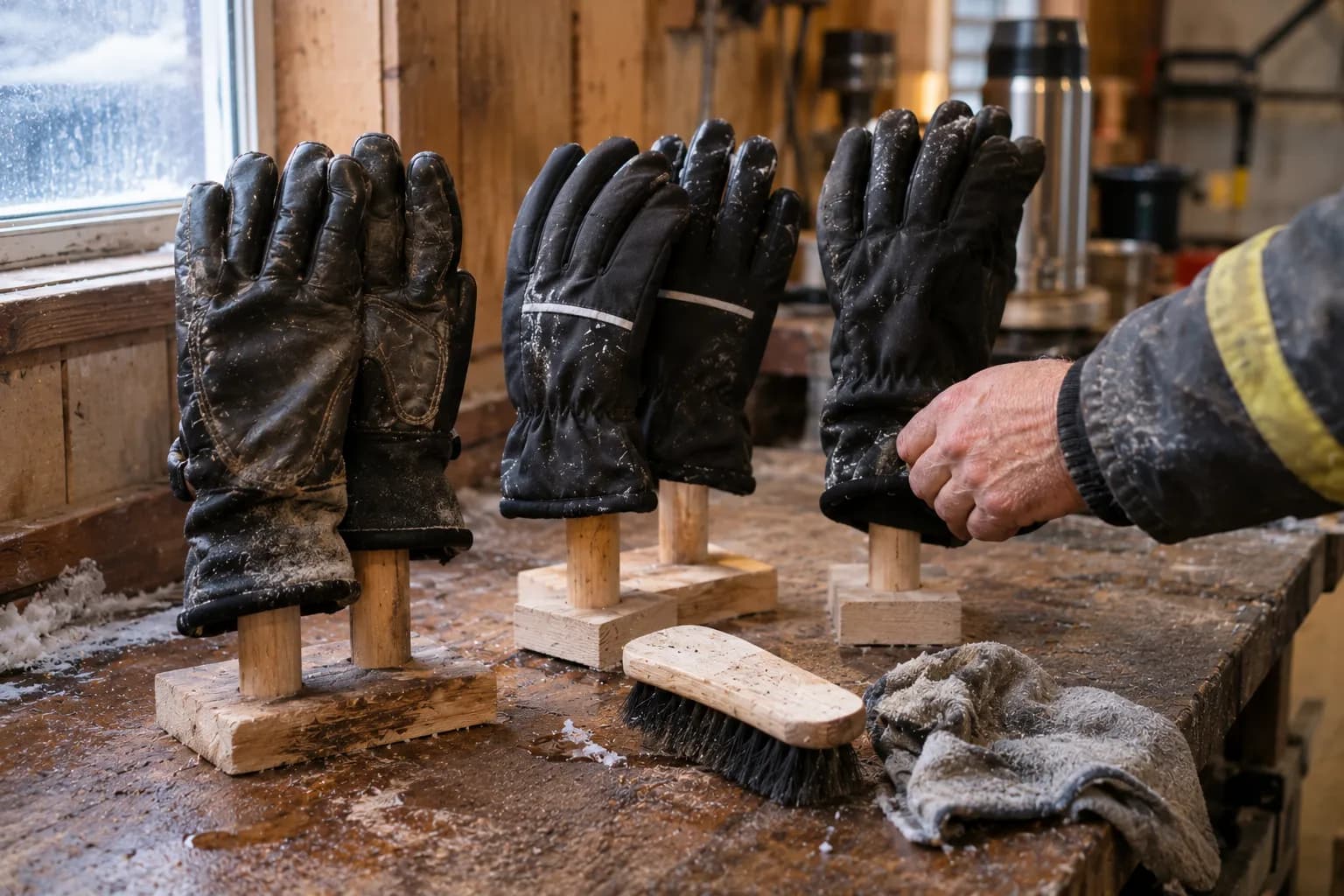
Direct heat is the fastest way to ruin a work glove. Leather dried on a radiator, a space heater or a vent shrinks, goes stiff and cracks at the knuckles. Synthetic insulation and waterproof inserts do not handle it well either. Dry gloves at room temperature with the cuff open, standing upright or hanging so air can move through them. A glove dryer that blows unheated or gently warmed air is fine. A heater pointed into the cuff is not.
Ease wet gloves off from the cuff rather than pulling at the fingertips. A damp liner turns inside out easily and rarely goes back in the way it came out. If it does come out, let it dry first, then work it back in gently, finger by finger, before you wear the glove again.
Why waterproof gloves dry slowly
A waterproof membrane keeps rain and meltwater out, but the moisture inside a glove is mostly sweat, and it has to escape through that same barrier. The CHILL-BLOC® Coldshield Gloves, Leather Grip Gloves and Softshell Insulated Gloves all carry a HiPora™ waterproof membrane or insert along with 100g Thinsulate™ plus foam, so a pair that is damp inside after a long shift can take overnight or longer to dry. That is normal. It is also why stuffing them in a pocket wet means starting the next shift with cold hands.
Loosely filling each glove with dry newspaper or paper towel for the first hour pulls out a lot of the water. Swap it once it is damp, then let air do the rest. Leave the cuff straps and closures open while they dry, so the opening stays as wide as possible.
Cleaning by material
Follow the label first. In general, leather wants as little water as possible: wipe off dirt and road salt with a damp cloth, let it dry slowly, then work in a leather conditioner if the label allows it, so the leather stays supple instead of drying hard. On the Coldshield gloves the leather exterior is reinforced with polyester; on the Leather Grip Gloves the palm is leather and the back is windproof polyester, so treat each part for what it is.
Neoprene, like the outer shell of the CHILL-BLOC® NeoGrip Gloves, usually takes a hand rinse in cool water with a little mild soap, then a slow air dry out of direct sun. Softshell gloves clean much the same way. Skip bleach and fabric softener on all of them, and do not machine wash or tumble dry unless the label says you can. Rinse well, because soap left in a lining holds water and smell.
Cuffs, straps and reflective trim
The cuff is the part of a glove that stays wet longest, and the part most people forget. Snow packs into it when you reach into a drift, and it sits against a damp sleeve all shift. Knock the snow off before you come indoors so it does not melt into the lining. The knit safety cuff on the CHILL-BLOC® Leather Grip Gloves holds water like any knit, so give it extra drying time and press it in a towel rather than wringing it.
Gauntlet cuffs, like the one with a wrist strap on the Coldshield gloves, dry faster with the strap fully open and close better once grit is brushed out of the strap. Reflective accents, panels and strips only work while they are clean, so wipe them with a damp cloth instead of scrubbing them with a brush, and shine a light on them now and then to check they still reflect.
Two pairs and the smell problem
The simplest fix for wet, cold and smelly gloves is a second pair. Wear one while the other dries fully, and swap every shift. Gloves that never dry all the way are where odor starts: sweat soaks into the lining and bacteria grow in the damp. A pair that dries completely between wears smells far less, and the insulation recovers its loft instead of slowly matting down.
If a pair already smells, clean it as the label allows and dry it properly before you reach for sprays. Masking the smell while the lining stays damp only delays the problem. Wearing a thin liner glove underneath, washed after every shift, also keeps a lot of sweat out of the insulated pair.
A drying spot at work
Picture a yard crew coming in at lunch with every pair soaked from loading in wet snow. If the only warm spot is a space heater, the gloves end up on it, and by spring half of them are stiff and split. A crew lead can prevent that with very little: a rack or a row of hooks in the break room, at room temperature, with a fan moving air across it if the room is still. Gloves hung there with the cuffs open dry far better over an hour than gloves balled up in a coat pocket.
Ask everyone to mark their gloves inside the cuff so pairs do not get mixed up, and keep a few spare pairs in common sizes for whoever starts the afternoon with only a soaked pair. Each person still owns the basics: bring a dry second pair, take the wet pair off before it turns cold inside, and hang it up instead of leaving it on a dash or a seat.
Mistakes that shorten a glove's life
Most ruined gloves are ruined in the same few ways. Hot water and a hot dryer shrink leather and can damage the lining and insulation. Wringing strains the seams. Leather conditioner rubbed into fabric or neoprene does nothing useful and leaves a greasy surface that holds dirt. And gloves sealed in a plastic bag while still damp can turn musty inside a week.
Storing them for the season
At the end of winter, clean each pair, dry it for longer than you think it needs, and condition leather if the label allows. Store gloves flat or loosely paired in a dry, breathable space, away from heat and sunlight. Do not leave them crushed at the bottom of a sealed bin or a truck box. Compressed insulation is slow to recover, and any trapped moisture turns into mildew by fall.
While you are at it, check the stitching at the fingertips, around the thumb and at the cuff, and look for a palm that has worn smooth. A glove that has started to split there is easier to replace now, when nobody is waiting on it, than in the first cold week.
Quick recap
Dry gloves slowly at room temperature with the cuffs open, clean them the way the label says, and keep a second pair in rotation so each one dries fully. Keep heat, wringing and sealed bags away from them, and they will stay warm, dry and supple far longer.