Coveralls or bib overalls: choosing for your job
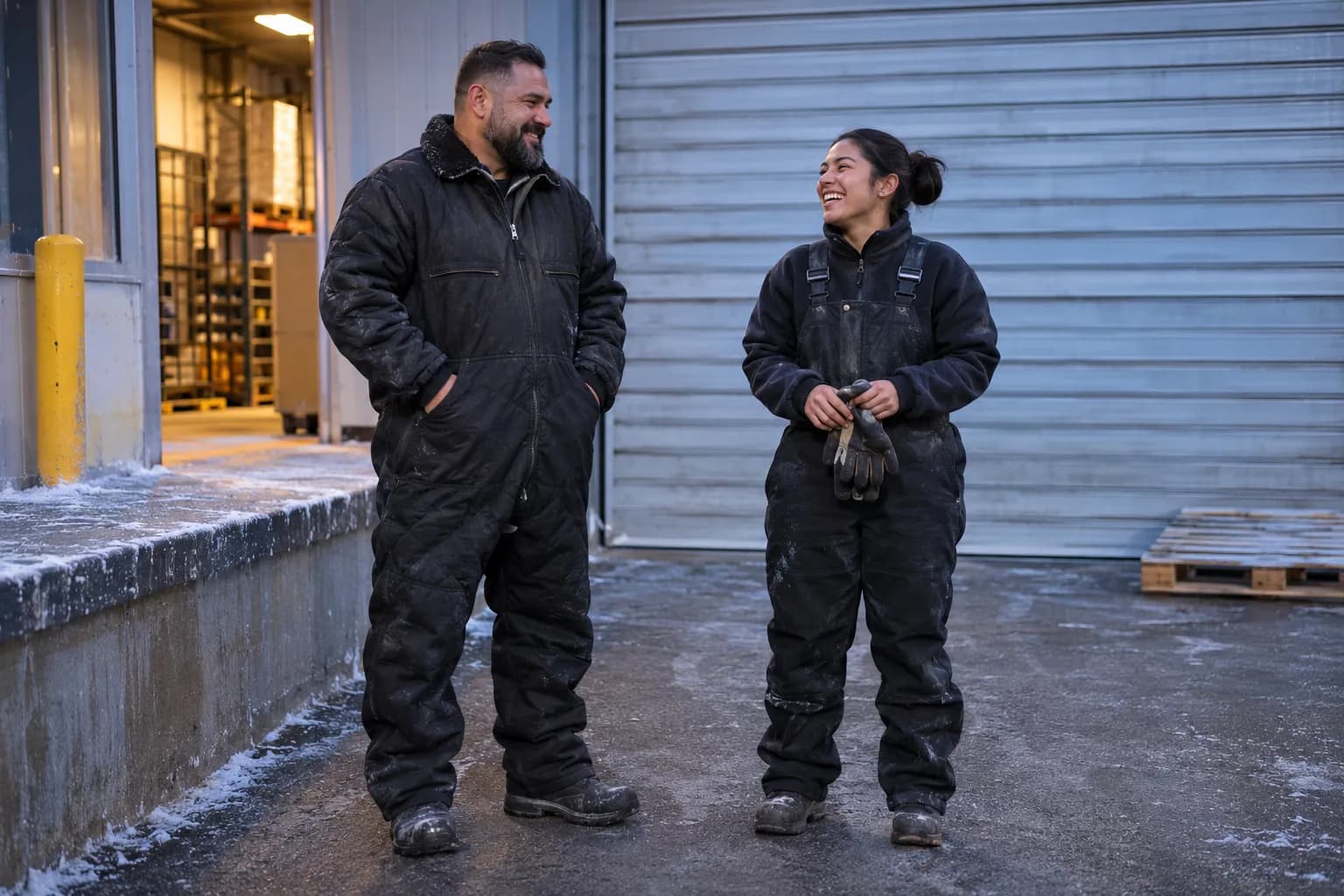
Insulated coveralls and insulated bib overalls start from the same idea: keep your core and legs warm through a long, cold shift. They differ in one place, the waist, and that single difference changes how each one behaves across a working day.
The quickest way to choose is to walk through your shift, not to compare spec sheets. How often you kneel, climb, sit, drive, take a break or step indoors will usually settle the question before warmth does. Start with the parts of the day you do not spend standing still.
What one piece does well
A coverall has no gap at the waist. When you bend to lift a case, reach overhead or crawl under a trailer, nothing rides up and no cold air finds the small of your back. That matters most for static work and for anyone who spends the whole shift in the cold, like a freezer crew or a rigger on an exposed deck. Coveralls are also quick: one garment, one zip, done.
Our coveralls are stated to −50°F and come in several builds. The CHILL-BLOC® Coveralls with Hood carry an attached, fleece-lined insulated hood. The Coveralls, No Hood are hood-free, so a hard hat sits properly, with a fleece-lined collar. The Hi-Vis Coveralls add reflective tape on the arms, waist and legs over a CORDURA® polyester shell, and the Fur Collar and Reflective Coveralls share the hooded build.
What bibs do better
Bibs give you two pieces instead of one. The bottom half stays on all day; the jacket comes off in the truck, at the dock or in the break room. If your day runs between heated spaces and the cold, that flexibility keeps you from sweating into your insulation, and sweat is what makes you cold an hour later.
The CHILL-BLOC® Bib Overalls use 300g insulation and a high front and back rise, so the chest and lower back stay covered even under a waist-length jacket. 2-inch adjustable suspenders hold them in place under load, and thigh-high leg zips let you pull them on over boots. Brass rivets and heel patches take the wear at the places bibs usually fail first.
Kneeling, climbing and driving
Kneeling and crawling work, along a slab or under equipment, favors the coverall. Folding up opens a gap between a jacket and pants that a one-piece never has. If you choose bibs for that kind of work, the high back rise earns its keep: the jacket hem and the bib should overlap well past your waist when you are bent over.
Climbing and driving pull the other way. Ladders and cab steps need knees that lift freely, and a full one-piece can bind across the shoulders and seat when you sit at a wheel all day. Bibs with a short jacket are easier to drive in and easier to climb in. Whichever you pick, do a deep squat and a high step in it at home before the tags come off.
Breaks, layers and hard hats
Restroom breaks never appear on a spec sheet, but on a ten-hour shift they matter. With a coverall, the top half has to come down, which means baring your torso in a cold portable toilet. With bibs, the jacket stays on and only the suspenders come off. With cold fingers and gloves in your pocket, that difference is easy to feel.
Layering differs too. Under a coverall, your mid layer is fixed for the shift. With bibs, the top can change through the day: a heavier jacket at dawn, a lighter one at noon. Over the head, a hood and a hard hat compete for the same space. If a hard hat is mandatory, choose a hood-free coverall, or bibs with a jacket that has no hood or a removable one, and wear a balaclava or headband underneath.
Getting the fit right
A coverall has to fit you in two directions: around the body and along the torso, from shoulder to crotch. If the torso is too short, the garment pulls across your shoulders and into your crotch every time you bend or reach, and the seams take a strain they were not built for. If you are tall for your chest size, or long in the body, check that measurement before anything else, and size up rather than live with a short torso.
Bibs are more forgiving. The 2-inch adjustable suspenders on the CHILL-BLOC® Bib Overalls take up the difference in torso length, so the chest and waist decide the size and the straps do the rest. Set them so the crotch sits close without pulling; straps left too loose let the crotch hang low and shorten your stride on stairs and ladders. With either garment, check the leg length with your work boots on: the hem should still cover the boot top when you kneel.
Mistakes that cost warmth
The most common one is buying coveralls for a job that keeps sending you indoors, then wearing them half off with the sleeves tied around your waist. That leaves your chest and back in a single layer, puts the insulation where it does nothing, and leaves two sleeves hanging where they can catch on equipment. If you find yourself doing that every shift, the job is telling you to wear bibs.
With bibs, the usual mistake is the jacket. One that stops at the belt line opens a gap at the back the moment you reach forward, even over a high-rise bib, so check the overlap by bending and reaching before you rely on it. And with either garment, close the leg zips all the way over the boot: an open zip at the ankle lets snow in and cold air up the leg for the whole shift.
Choosing for a mixed crew
On a crew, one answer rarely fits every role. A loader who spends the shift in a freezer, a rigger on an exposed deck and an operator who climbs in and out of a cab all face the same cold in very different ways. Leads and supervisors usually get better results by matching the garment to the role than by issuing one style to everyone, and by letting people try both before a large order goes in.
Visibility is the one thing worth keeping consistent. If the site requires hi-vis, the visible layer has to be the outermost one. On a coverall, that is the coverall itself, which is where the Hi-Vis Coveralls come in; a crew in bibs needs its visibility on the jacket, because the jacket is what covers the bib. Either way, check the garment label against what the site or contract asks for.
A quick way to decide
If you spend the whole shift in the cold, stay mostly in one place, or kneel and crawl a lot, start with coveralls. If you move in and out of warm spaces, drive between jobs, climb often, or want to change your top layer as the day warms up, start with bibs and a separate jacket.
Plenty of people end up owning both: coveralls for the coldest, most static days and bibs for everything else. Either way, size the garment over the layers you will actually wear underneath, not over a t-shirt, and test it by kneeling, squatting and reaching before you commit.