Delivery driving in winter: dressing for in-and-out work
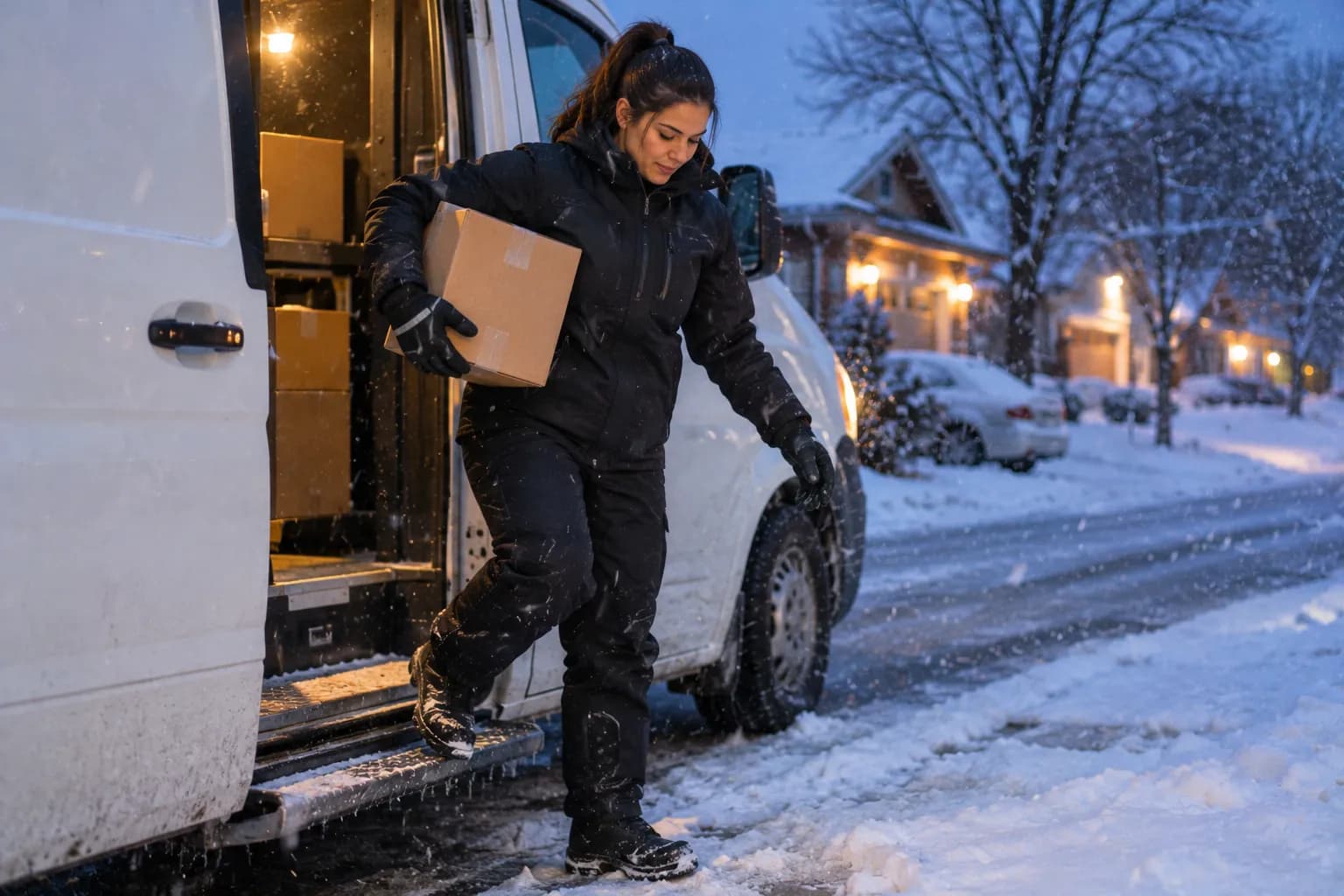
Delivery work turns the usual cold-weather advice upside down. You are not out in the cold for hours at a stretch. You are in a heated cab, then on an icy sidewalk for two minutes, then back in the cab, and you repeat that dozens of times before lunch.
Dress for a blizzard and you sweat at the wheel, then step out damp into the wind. Dress for the cab and you freeze at every door. The answer is clothing you can drive in, adjust in seconds, and be seen in.
A jacket you can drive in
A long, heavy parka works against you behind the wheel. It bunches under the seat belt, rides up around your hips and makes reaching across the cab awkward. A shorter softshell or work jacket moves with you, blocks the wind at the door, and does not overheat you on the road.
The CHILL-BLOC® Polarlite Softshell Parka is built with this kind of work in mind: a lightweight softshell that blocks wind and light rain, with a removable thermal lining, a detachable hood and a padded collar. On milder days, leave the lining out; on cold ones, zip it in. Zippered pockets keep keys and a phone from falling out every time you climb down, and adjustable cuffs close the gap at the wrist.
Hood off, head covered
A hood blocks your side view when you check mirrors, back out of a driveway or cross a street with a parcel in your arms. A detachable hood can stay in the cab until sleet or snow calls for it.
For the head and face, something small you can pull on and off with one hand works better. The CHILL-BLOC® Fleece Neck Gaiter covers the nose, mouth, ears and neck, packs small, and drops down to your collar the moment you are back behind the wheel. Pull it up at the door, push it down in the cab.
Gloves for the wheel and the parcel
A driver's gloves need to grip a steering wheel, a parcel and a handrail, and they should not have to come off to work a scanner or a phone. The CHILL-BLOC® NeoGrip Gloves have a neoprene shell that is windproof and water-resistant, a reinforced palm for grip, a touchscreen index finger and reflective strips.
Very thick gloves that are fine for standing still can make steering and small buttons clumsy. If you carry two pairs, keep the spare in the cab, not in the cold cargo area, so they are dry and warm when you change into them.
A route, start to finish
Picture a winter route that starts with loading at the depot before dawn, runs through a morning in the teens and warms toward freezing by mid-afternoon. Loading is the coldest part of that day and the most static: standing at an open dock door or in the back of a van, sorting and stacking. That is the time for the thermal lining zipped in, the gaiter pulled up and your warmest gloves.
Once the route starts, the cab does the warming between stops. By early afternoon the lining may be too much even outside, and taking it out for the rest of the day beats sweating through it. The cargo area, though, stays cold all day: a long search for parcels in the back at a stop is a moment to close up and pull the gaiter back up, even if the sun is out.
Being seen at the curb
In winter, much of a route runs in the dark or at dusk, when windshields are dirty and other drivers are tired. You are often on foot in the street, between parked cars or at the back of your own van with the doors open. Bright color on the outer layer helps in twilight; reflective material is what headlights pick up after dark.
If your employer requires hi-vis, follow their rules and check the garment label. If not, a bright outer layer still helps. The CHILL-BLOC® Hi-Vis Orange Jacket and Hi-Vis Lime Jacket are softshells with a removable thermal lining, like the Polarlite, and the reflective strips on NeoGrip gloves catch the light when you raise a hand to wave a driver past.
Spare layers and icy steps
Sweat is the hidden problem. Every time you climb back into a hot cab in a layer that was right for outside, you get damp, and damp clothing loses its warmth fast the next time you step out. Open the jacket or take the lining out while you drive, and keep a dry spare base layer, socks and gloves in the vehicle, along with the blankets and supplies that winter vehicle kits should carry in case you get stuck.
On a winter route, the road is not the only hazard. Cab steps, ramps and porches ice over, often where you cannot see it. Use three points of contact getting in and out of the cab, two hands and a foot or two feet and a hand. Wear footwear with good tread, take short, flat-footed steps on ice, and keep one hand free whenever you can.
Legs, feet and traction
Drivers often dress the top half for winter and leave the legs in ordinary work pants. That works for curbside drops, but a long walk across a parking lot or several flights of outdoor stairs at an apartment complex leaves the legs in the wind for much longer. A thin base layer under work pants adds warmth without making the cab uncomfortable, and is easier to live with than heavily insulated trousers.
Feet take the worst of the transitions. Snow packed on a boot melts in the warm cab and soaks in, then the wet boot meets the cold at the next stop, so waterproof boots matter as much as warm ones. Slip-on ice traction devices help on sidewalks and driveways, but take them off before you drive. Metal studs on a pedal are a hazard, and they can be slippery on smooth indoor floors and metal steps.
What employers and dispatchers can do
Much of a driver's winter risk is set before the van leaves the depot. Routes with no slack for snow push people to rush on ice, so allow extra time when the forecast turns. Make sure every vehicle carries its winter kit, that drivers know who to call if they are stuck or hurt, and that someone checks in on anyone working a remote or rural route alone.
If hi-vis is part of the uniform, issue it in a form people will actually wear. A jacket that fits over winter layers gets worn; a vest that will not close over a parka ends up in the door pocket. And make the depot a place to warm up and dry out at the start and end of the day, with somewhere to hang wet gear overnight.
Quick recap
Dress for the doorstep in layers you can open, remove and put back on in seconds, and let the cab do the warming between stops. Keep spares in the vehicle, keep your outer layer bright and your side view clear, and treat every step down from the cab and every icy porch as a place to slow down.