Hi-vis explained: what the classes and colors mean
Hi-vis is often bought by color alone. In the US, the garments a job site expects are usually described by a voluntary consensus standard, ANSI/ISEA 107, and the label inside a garment tells you more than its color does. Knowing how to read it saves you from buying something that looks right but is not what your site asks for.
This is a general guide, not a compliance checklist. Your employer, your site safety plan or the agency that controls the road decides what you have to wear. Use what follows to understand their requirement and to ask the right questions.
Types: where you work
The standard first sorts garments by work environment. Type O is for off-road work, such as warehouses, yards and oil fields, where people are not exposed to traffic on a public road. Type R is for roadway work and temporary traffic control, where vehicles pass close by. Type P is for public safety roles, such as police, fire and emergency responders, who also need access to equipment on a belt.
Classes: how much of you can be seen
Within those types, performance classes describe how much fluorescent background material and retroreflective tape a garment carries, and where it sits. Class 1 is the minimum and applies only to type O. Class 2 adds more material for work closer to traffic. Class 3 adds the most, including on the sleeves, so the full outline of a person is recognizable from a distance.
There is also class E, which covers bottoms such as pants, bibs and shorts. A class E garment does not meet the standard on its own, but worn together with a class 2 top it makes a class 3 ensemble. That is a useful route in winter, when a vest alone covers only part of a heavily dressed body.
Reading the label
A garment made to the standard says so on its label. Look for the standard's name, usually with the year of the edition it was tested to, and the type and class it meets, often shown as a small pictogram as well as in words. Read the care instructions on the same label too: washing and drying a garment in ways the label does not allow can dull its color and tape well before their time.
If a garment says only "hi-vis" or "reflective" and names no type or class, treat it as a bright garment with reflective trim, not a rated one. That may be all your work needs, for example in a yard where no one specifies a class. It is not the same as a class 2 or class 3 garment, though, and it will not satisfy a site plan or contract that calls for one.
Lime or orange
The standard allows three background colors: fluorescent yellow-green, fluorescent orange-red and fluorescent red. Fluorescent material looks so bright because it turns part of the daylight that falls on it, including light the eye cannot see, into visible color. That is why it stands out at dawn, at dusk and on gray winter days, when ordinary bright colors look dull.
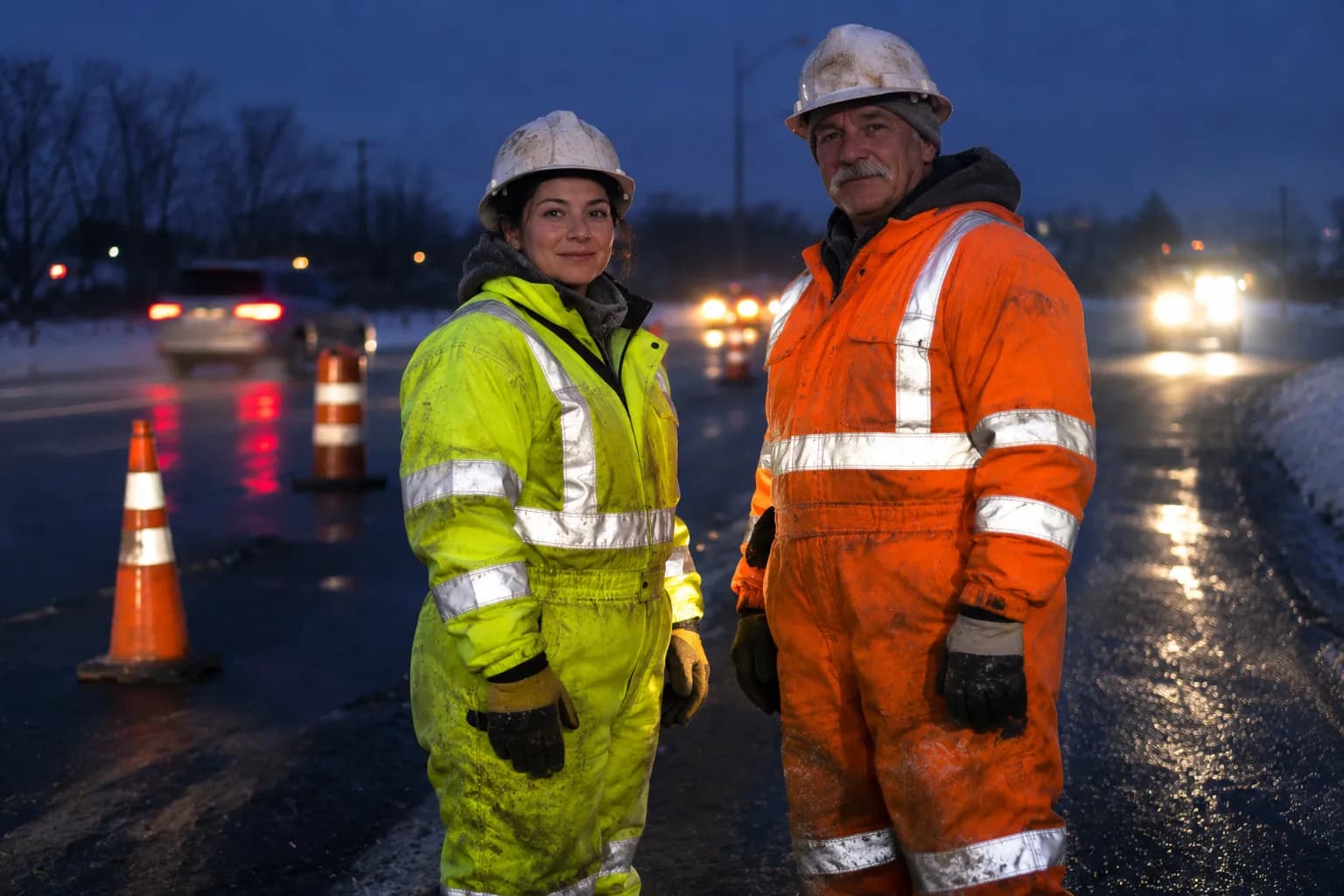
Neither color wins everywhere. What matters is contrast with what is behind you. Yellow-green is widely seen as the most conspicuous in daylight and twilight, but it can blend into yellow machinery; orange-red reads clearly against green landscape and is traditional in road work. Some sites assign one color to a trade or a role, so check before ordering for a crew. Our CHILL-BLOC® Hi-Vis Coveralls come in both Lime and Orange.
Reflective tape is for the dark
Fluorescent color does little at night. After dark, the work is done by retroreflective tape, which sends light back toward its source. It shines brightest for the person whose eyes are close to the light, which is why tape glows in a driver's headlights but can look plain gray to a coworker standing off to the side. Bands around the arms, waist and legs show a driver the shape of a moving person, not a sign or a barrel.
Tape wears out. Grime, road salt, abrasion and repeated washing all dull it, and cracked or peeling tape means the garment is near the end of its life. A simple check: in a dark room, hold a flashlight beside your eyes and shine it at the tape from across the room. If it no longer lights up, or the background color has faded, replace the garment rather than patching it.
Hi-vis in winter
Winter creates a problem no standard solves for you: layering. A hi-vis vest under a parka does nothing at all. A vest over a parka can ride up, snag, refuse to close or end up left in the truck. The cleaner answer is an outer layer that is both insulated and high-visibility, so the visible layer is always the outermost one.
The CHILL-BLOC® Hi-Vis Coveralls do that in one piece, with reflective tape on the arms, waist and legs over insulation stated to −50°F. Our product pages describe their reflective banding, not a performance class, so read the garment label and compare it with what your site or contract requires before you buy for a crew.
Mistakes that hide you
Most visibility is lost after the garment is bought, not before. A fall-protection harness, a tool belt or a backpack can cover the very bands that make a person recognizable. If you wear a harness, try your outer layer on with the harness over it, and check in a mirror that the tape on your torso still shows from the front, the back and the sides.
Other common mistakes are a hi-vis jacket worn open so the torso bands break up, a garment sized over a t-shirt that will not close over winter layers, and mixing pieces on the assumption that they add up to class 3. Only a labeled class E bottom worn with a labeled class 2 or class 3 top makes a class 3 ensemble. An ordinary pair of bibs under a class 2 vest does not.
For supervisors and crew leads
Get the requirement in writing before the season starts: the type and class, the colors allowed, and whether it applies to everyone on site or only to people near traffic and moving equipment. Then check what the crew actually owns against it. Garments that were fine last spring may be faded, torn or caked in grime now. Deciding when to retire one is its own subject, but someone has to look.
Keep a few spares for visitors, new starters and anyone whose garment is soaked or damaged mid-shift. And treat clothing as the last line of defense, not the first. Lighting, traffic control, spotters and keeping people out of vehicle paths do more than any garment can, and hi-vis works best on a site already planned so that drivers expect to see people on foot.
Quick recap
The type tells you where a garment is meant to be worn, the class tells you how much of you it shows, and the label is the only place either one is stated. Fluorescent color works in daylight and twilight, reflective tape works in headlights, and both only do their job on the outermost layer with nothing covering them.